Understanding X Interaction Circles: Why Replies, Quotes & Recency Beat Follower Count
Learn how public X interaction scoring works—reply vs quote vs mention weights, 30-day recency decay, mutual bonuses, and how creators use circles to spot true superfans.
XCircle Editorial ·
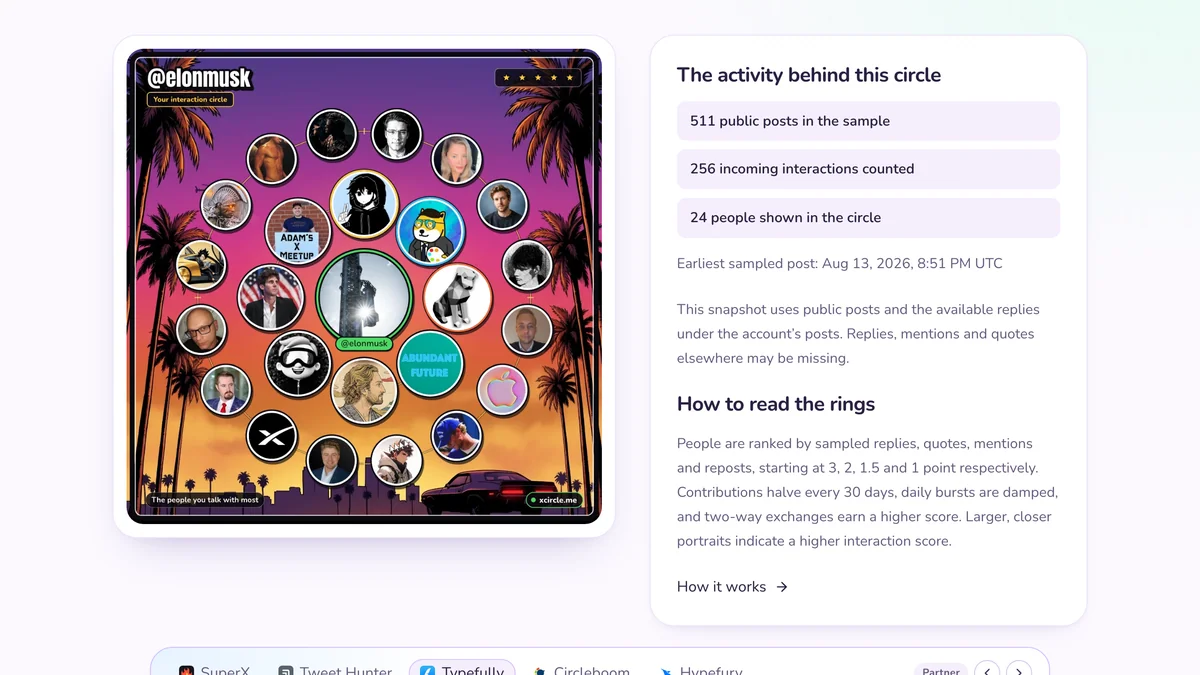
Follower count is the loudest vanity metric on X—and often the least useful one. An account with 40,000 followers can post to near silence, while a 2,500-follower builder has a tight group of 20 peers replying, quoting, and testing every launch.
An X interaction circle cuts through follower count by mapping active public conversations. Understanding how the ranking works turns a fun shareable picture into a genuine audience-health check.
Why different interactions carry different weights
Not every public action signals the same level of engagement. In XCircle's scoring model, each visible interaction type starts with a different weight:
| Interaction Type | Starting Weight | Signal Strength |
|---|---|---|
| Reply | 3.0 | Direct conversation; requires reading and writing a response |
| Quote Post | 2.0 | Public endorsement or commentary shared to the quoter's own audience |
| Visible Mention | 1.5 | Deliberately tagging a handle inside the body of a post |
| Repost | 1.0 | Low-friction amplification without added commentary |
Two guardrails keep the ranking honest:
- Reply-prefix filtering: When X automatically prepends
@user1 @user2 @user3to a thread reply, those hidden reply headers are not counted as extra body mentions. - Same-day burst damping: Exchanging 15 rapid-fire replies in a single afternoon shouldn't outweigh someone who talks with you consistently over three different weeks. Spreading interactions across multiple days earns stronger standing.
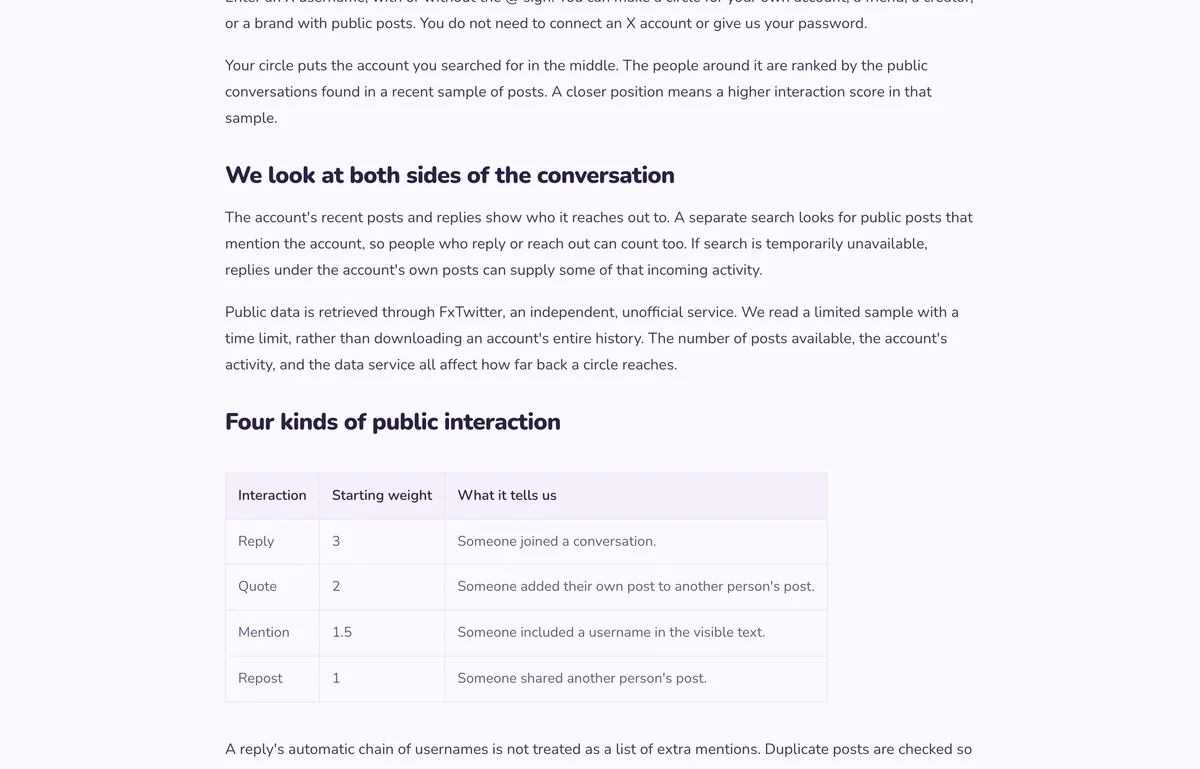
XCircle's public methodology page documents the exact starting weights and anti-spam guardrails used to rank every ring.
Why recency (30-day half-life) matters
Communities evolve quickly. Someone you collaborated with closely in January might have shifted topics by autumn. XCircle applies an exponential 30-day half-life, meaning an interaction from 30 days ago counts for roughly half as much as the exact same interaction today.
That keeps your inner ring anchored to who is showing up for you right now, rather than freezing your circle in last year's conversations.
Mutual conversation vs one-way fandom
One of the sharpest insights in an interaction circle is distinguishing two-way peers from one-way reach:
- Mutual conversations (both accounts reply to or quote each other) receive a mutual bonus, surfacing true peers, collaborators, and core community members in the innermost ring.
- One-way outgoing replies show up when you spend most of your time replying under large accounts—useful if you are running a deliberate "reply-guy" discovery strategy, and a clear signal if you haven't yet built a core group replying back to your own posts.
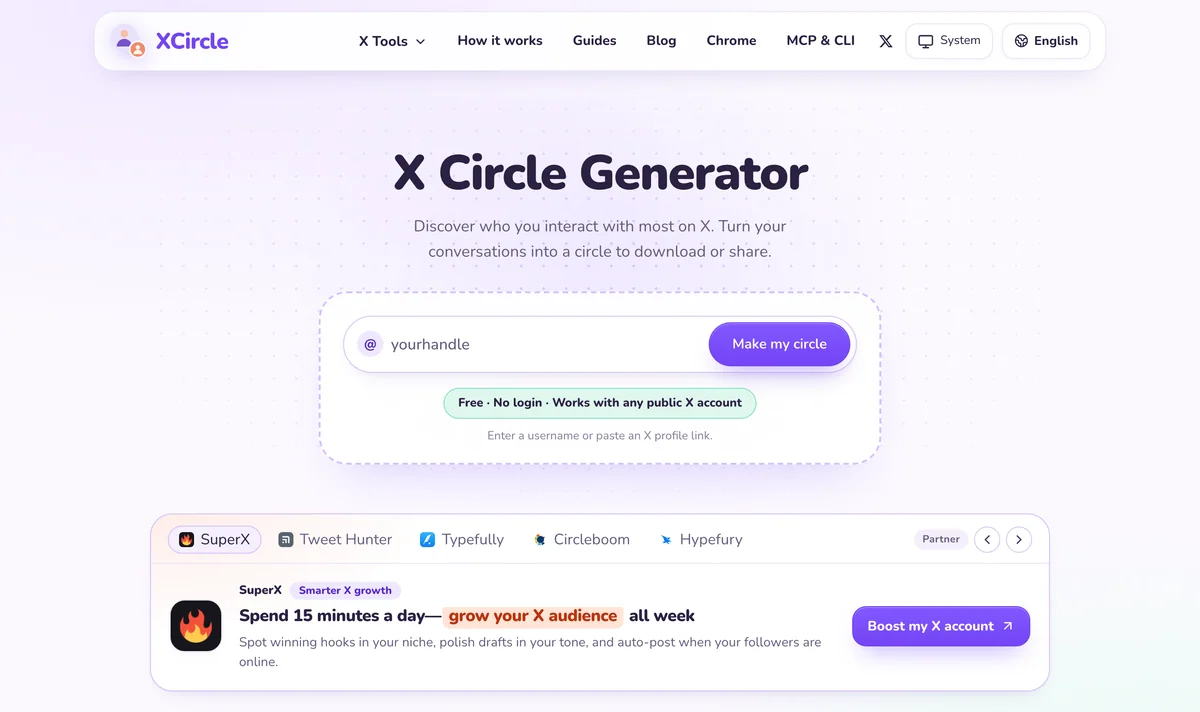
Enter any public @handle on the XCircle homepage to generate a fresh 24-person or 50-person circle without logging into X.
Three ways creators use their circle productively
- Audit your reply habit once a month: Generate a 24-person circle on the XCircle homepage and check whether your inner ring consists of peers in your niche or random viral threads.
- Spot overlooked superfans: The second and third rings (ranks 9–50) often reveal quiet supporters who quote or reply regularly. Following back, thanking them, or inviting them into beta tests compounds loyalty.
- Pair circles with short-window recaps: While a circle captures multi-week conversation depth, X Recap highlights your last 3 or 7 days of posting cadence and reply balance—ideal for weekly creator reviews.
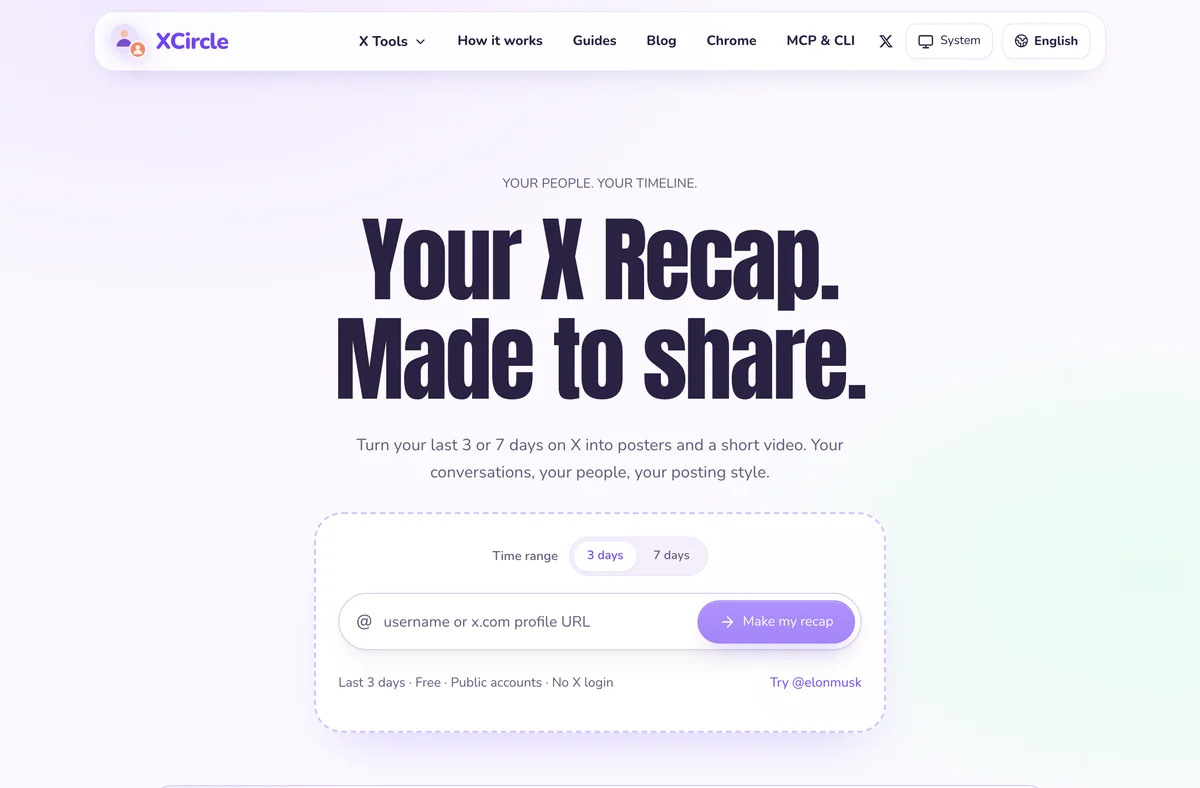
Use X Recap alongside your monthly interaction circle to track short-term 3-day or 7-day posting cadence and conversation momentum.
What an interaction circle cannot measure
No public tool can see private DMs, bookmarks, profile visits, or likes (which X hides from public views). Treat your circle as an accurate map of public conversation momentum, never as a scorecard of real-world friendship.